The right excavator for a job is rarely the biggest one available. It is the one that fits the site, reaches the work, and moves the material without wasting fuel or damaging the ground it stands on. That balance shifts a long way between a tight residential block and an open commercial site, which is why excavator size is one of the first questions worth settling before any purchase or hire decision.
Size in an excavator is usually described by operating weight, from the smallest one-tonne machines up through the compact and mini classes to larger civil machines beyond 10 tonne. Each step up brings more dig depth, more reach and more digging force, but also more weight, a larger footprint and higher transport and running costs. The task is to match those trade-offs to the work rather than defaulting to the machine that can do everything.
This guide looks at how the sizing question changes between residential and commercial projects, and what to weigh up before comparing a takeuchi excavator for sale.
What residential sites demand
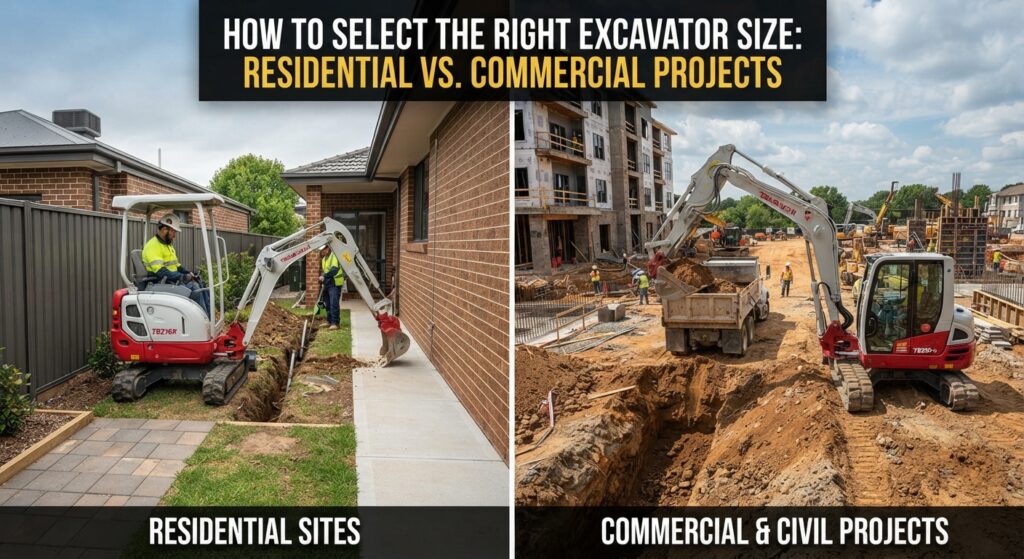
Residential work is defined by constraint. Access is often through a side gate, between a house and a fence, or across a finished surface that cannot be torn up. Working room is tight, boundaries are close, and there are usually services, structures and landscaping to work around. All of that points towards a smaller machine.
Compact and mini excavators suit this work because they fit through standard access, turn in confined space, and exert lower ground pressure on finished surfaces.
A reduced or zero tail swing design, where the rear of the machine stays within the width of the tracks, lets an operator work hard up against a boundary or a wall without the counterweight overhanging into a fence or a neighbouring block. For pool digs, footings, drainage, landscaping and service trenches on a suburban site, the smaller classes usually do the work better than a machine that struggles to get in the gate.
Transport is part of the calculation too. A machine light enough to move on a standard trailer behind a suitable vehicle is far cheaper and quicker to shift between residential jobs than one that needs a float every time. For a contractor moving daily between small sites, that difference adds up fast, and it is worth weighing before comparing a takeuchi excavator for sale.
What commercial and civil sites demand
Commercial and civil projects change the priorities. Access is usually less of a constraint, working room is larger, and the volume of material to move is far greater. Here the sizing question moves towards dig depth, reach, breakout force and cycle speed, because the machine needs to shift more material and dig deeper trenches and foundations within a sensible timeframe.
A larger excavator brings the reach to load trucks from a stationary position, the depth for deep services and basement work, and the digging force for harder ground and rock. On a project measured in weeks or months of bulk excavation, an undersized machine becomes the bottleneck that holds up every trade behind it. The extra transport and running cost of a larger machine is justified when the volume of work keeps it busy.
That said, bigger is not automatically better even on commercial sites. Many larger projects still need a compact machine for detail work, trenching around services, and jobs in areas the big machine cannot reach. Fleets often pair a larger excavator for bulk work with a compact one for the finish and access work, using each for what it does best.
Weight, transport and ground conditions
Operating weight drives more than digging capacity. It sets the transport method, the ground pressure the machine exerts, and how it behaves on soft or finished surfaces. A heavier machine digs harder and reaches further but needs proper float transport and can mark or bog on ground a lighter machine crosses comfortably.
Reading the ground conditions and the transport logistics alongside the digging requirement gives a truer picture of the right size than the dig figures alone.
Anyone weighing up a takeuchi excavator for sale should map the realistic range of sites the machine will see, not just the largest job. A machine sized for a single big project can prove a poor fit for the steady stream of smaller work that fills the calendar in between.
Matching the machine to the mix of work
Most contractors do not work exclusively on one type of site. The practical question is which size covers the majority of the work well, with hire filling the gaps at the extremes. An operator whose bread and butter is residential and light commercial is usually better served by a versatile compact machine, hiring a larger excavator for the occasional big dig, than by owning a large machine that spends half its life too big for the job in front of it.
Working the other way, a civil contractor on larger projects will own the larger machine and hire or subcontract the detail work. Buying to the core of the work, and being honest about how often the extreme jobs actually come up, is what protects the value of a purchase over years of ownership. It is the single most useful lens to apply when comparing a takeuchi excavator for sale against the work ahead.
Getting the decision right
Excavator sizing rewards a clear-eyed look at the real work: the sites, the access, the material, the depth, and how the machine will be transported between jobs. For anyone searching for a takeuchi excavator for sale, the right size is the one that handles the bulk of the work comfortably and holds its value, not the largest the budget stretches to.
For buyers working through that decision, Toyota Takeuchi can talk through the size classes and match a machine to the mix of residential and commercial work, backed by genuine parts and the national service network of Toyota Material Handling Australia. Getting the size right at the outset is what keeps an excavator earning on the jobs that pay for years to come.