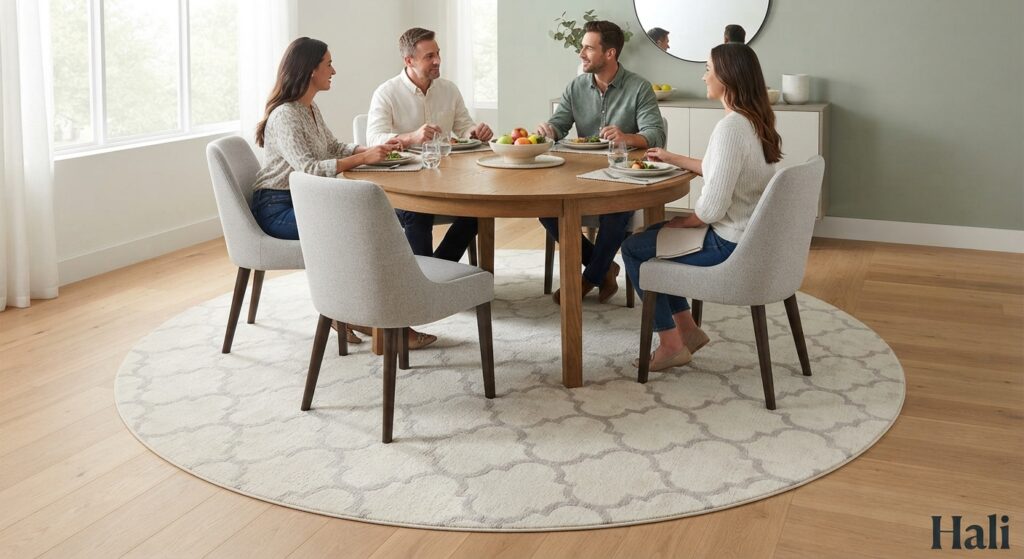
Size is the detail that makes or breaks a rug in a dining room. Get it right and the table feels anchored and the whole room reads as considered. Get it wrong and chairs catch on the edge, the rug looks like a placemat under the table, and something feels off without anyone quite knowing why.
The good news is that sizing a dining rug is not guesswork. A few simple measurements and rules take almost all the risk out of it. Here is how to choose dining room rugs that fit the table, the chairs and the room they live in.
Start with the chairs, not the table
The single most important rule for dining room rugs is that the rug must be large enough to hold the chairs, even when they are pulled out.
People instinctively size a rug to the table. The problem shows up the moment someone sits down: the back legs of the chair drop off the edge of the rug, the chair rocks, and the effect is both awkward to use and awkward to look at. The rug needs to sit under the table and every chair around it, with room to spare.
The number to remember is 75 centimetres
As a working rule, the rug should extend at least 75 centimetres beyond every edge of the table. That is roughly the distance a chair travels when someone pushes back to stand up, so it keeps all four legs on the rug throughout.
To size it, measure your table, then add 150 centimetres to both the length and the width, which is 75 on each side. That gives you the minimum rug footprint. If the room allows, a little more is better than a little less, because a generous rug always looks more deliberate than a mean one.
Match the rug shape to the table shape
As a rule, the rug should echo the table. A rectangular table suits a rectangular rug, a round table sits beautifully on a round rug, and a square table works on either a square or a round one.
A round rug under a round table is one of the most satisfying pairings in a dining room, softening a space that can otherwise be all straight lines. Just apply the same clearance rule to the diameter: the rug should be wide enough to keep pulled-out chairs on it all the way around.
Read the room, not just the table
A rug that fits the table can still be wrong for the room. Step back and check the proportions of the whole space.
In an open-plan area, the dining rug also helps define the eating zone, so it should feel balanced against the nearby living or kitchen area rather than crowding it. In a dedicated dining room, leave a reasonable border of floor visible around the rug rather than running it wall to wall. That margin frames the rug and lets the room breathe.
Choose a material that earns its place
A dining room is a working room, and spills, crumbs and dragged chairs come with the territory. That makes construction and fibre as important as size.
Flatter, densely woven rugs handle chairs moving in and out far better than deep, high-pile ones, and they are easier to clean. Wool is naturally forgiving with spills, which is worth knowing under a dining table. A patterned or mid-tone design will also disguise the occasional mishap better than a pale plain one. When you are comparing dining room rugs, weigh liveability alongside looks.
Where to get sizing right the first time
If you are unsure, measure your table and take the numbers with you, or ask for help. A good rug specialist will size a rug to your exact table and room rather than sell you a standard size that nearly fits.
Hali’s in-house interior design consultations do exactly this, and its custom rug program can make a piece to a specific size when a room falls between the standard dimensions, which dining spaces often do.
Get the scale right and the rest follows
Getting the size right is most of the battle with dining room rugs. Hold the chairs, clear the table by 75 centimetres, echo the table shape, and leave the room some breathing space. Do that and the rug will look like it was always meant to be there.
See a few in person if you can, because scale is one of those things that is far easier to judge with the rug underfoot than on a screen. The best dining room rugs are the ones sized for your table and chosen for how your household actually eats.